Restoration brings endangered egrets to China’s Yellow Sea coast_我的网站
A |
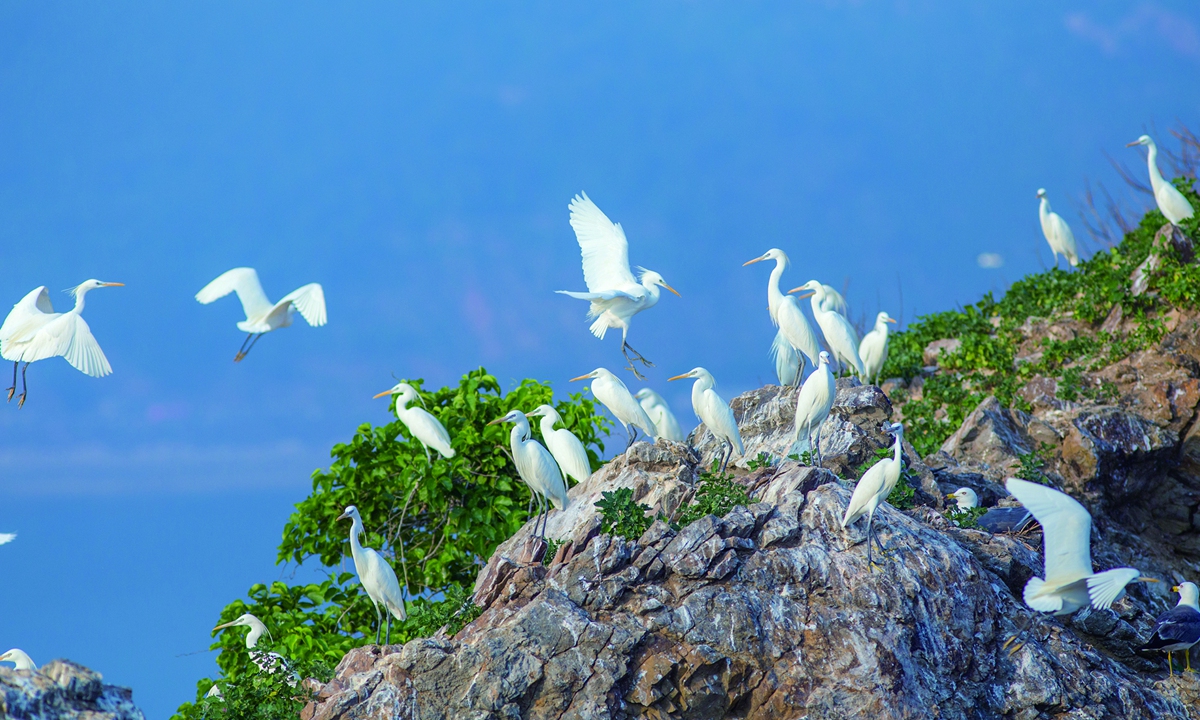
A group of Chinese egrets on Fantuozi Island in Dalian, Northeast China's Liaoning Province Photo: Courtesy of Changhai County People's Government At 5 am, Wang Piyu, deputy director of the Changhai County Natural Resources Affairs Service Center, sets out by patrol boat for Fantuozi Island, a core breeding site for Chinese egrets in the Changshan Archipelago, Northeast China's Liaoning Province. The island has no permanent residents. About 100 meters from the island, Wang turns off the engine and reminds accompanying researchers to keep their voices low to avoid disturbing the nesting birds. Stepping onto the island, they walk along paths covered with vines. Scattered across the rocky slopes are nests measuring 40 to 50 centimeters in diameter. Inside, fluffy chicks huddle together among soft grass woven into nests, while adult birds perch high in the trees, watching cautiously. "This was not what the island looked like 10 years ago," Wang recalled. "People used to collect eggs here, and coastal aquaculture polluted the tidal flats. Many parts of the island were bare, leaving little vegetation for birds to nest." The recovery of Changshan Archipelago, however, has turned the remote archipelago into an important link in global conservation efforts. At the 48th session of the UNESCO World Heritage Committee in Busan, South Korea, the boundary modification of the Migratory Bird Sanctuaries along the Coast of Yellow Sea-Bohai Gulf of China was approved, officially adding the Changshan Archipelago to the World Heritage site. The expansion further strengthens the integrity of the serial natural heritage site, following a previous update in 2024, and highlights China's efforts to integrate coastal ecosystem conservation, according to the National Forestry and Grassland Administration. Behind the World Heritage recognition lies years of conservation work involving local authorities and island residents.
An aerial view of Changshan Archipelago in Liaoning Province Photo: VCGBuilding a bird haven Located in the northern Yellow Sea off Dalian, the Changshan Archipelago sits along a key route of the East Asian-Australasian Flyway, providing an essential stopover where tens of millions of migratory birds replenish their energy during their journeys across the Bohai Sea. The newly added area covers more than 4,900 hectares and is home to more than 140 recorded bird species, including the Chinese egret and black-faced spoonbill, both listed as China's national first-class protected animals. In 2015, more than 300 Chinese egrets arrived in Changhai county. After discovering the birds, local authorities introduced a series of protective measures, including establishing patrol teams and installing remote monitoring systems to reduce human disturbance. However, the growing bird population also created new challenges. Less than half of Fantuozi Island was covered by shrubs, which serve as the nesting grounds for the egrets. Additionally, the island's poor soil and acidification caused by years of accumulated bird droppings had led to the withering and death of some shrubs in recent years. From 2022, the county launched an ecological restoration project, replacing surface soil with fertile earth and planting more than 2,200 shrubs. The efforts helped restore the breeding habitat. The number of Chinese egrets on the island has since recovered, with this year's population estimated at about 3,500, including around 1,500 adults and nearly 2,000 chicks, according to Lü Yongquan, director of Changhai county's natural resources bureau. "Chinese egrets are highly sensitive to water quality, vegetation and human disturbance. Their return to breed here is a sign that the marine ecosystem has recovered and is thriving," Lü told the Global Times. From fishermen to guardians Conservation in Changhai is not only carried out by authorities. Local communities have also gradually become part of the protection network. Authorities have expanded public awareness campaigns and strengthened patrols. Because most of the Changshan Archipelago is uninhabited, drones, fixed-point infrared cameras, and on-site inspections are used to monitor the islands and reefs around the clock. Many fishermen who once relied on the sea for their livelihoods now help protect it. During the peak breeding season from April to July, regular marine patrols are carried out to protect nesting sites and prevent illegal egg collection and habitat damage. Local bird conservation groups and research institutions have also joined the efforts, while fishermen have taken on new roles as volunteer guardians of the islands. Across Changhai county, many fishermen now actively participate in coastal patrols to help protect the archipelago's biodiversity. For Li Qingsen, a 50-year-old island native and member of the county's forest fire brigade, protecting the birds has become a way of life. From spring to autumn, 20 team members take turns staying on Fantuozi Island in pairs to protect the birds from disturbance. Life on the 0.08-square-kilometer island is far from easy. There are no freshwater sources or docks. Patrol workers carry large barrels of water and wade ashore from boats anchored offshore. Instant noodles are often their main food because they require little preparation and some water. Their work is closely tied to the seasonal cycle of the birds. Each April, thousands of Chinese egrets arrive in the archipelago from Southeast Asia to breed and rear their young, staying until early September before migrating south for the winter. At present, young egrets are already practicing flight above the treetops. By autumn, they will join their parents in a southward migration. For Wang, who has spent half of his life guarding Fantuozi Island, the World Heritage recognition is both a homecoming for the birds and a reward for years of protection. "Now, it is a home for the birds, and a reward for all the years we have spent protecting it." 。
B | 目前,中国第16次北冰洋考察队“雪龙2”号正在北纬84度附近的北冰洋中央区开展冰站作业。“雪龙2”号本航次将在7个冰站开展冰基浮标布放、冰芯采样、海冰遥感观测等20余个作业项目,全面观测海冰融化过程中大气、海冰、上层海洋以及冰下生态过程动态变化的相关参数,为研究北冰洋海冰快速变化及其机理和生态系统演变获取科学数据。 8月9日,“雪龙2”号停在作业冰区后,两名考察队员先上冰进行钻孔测厚,识别潜在危险区域、确定作业范围和分区。 8月9日,作业前,“雪龙2”号上的吊车将雪地摩托等大型考察物资放置到作业冰面。 8月9日,考察队员在冰站上分组作业。 8月9日,考察队员在测量积雪厚度。
C | 8月9日,考察队员在布放冰基浮标。 8月9日,考察队员在布放冰基浮标。 8月9日,考察队员在布放冰基浮标。 8月9日,考察队员在布放冰基浮标。 8月9日,考察队员在钻冰。
D | 8月9日,考察队员在进行冰下水采样。 8月9日,考察队员分装采集到的冰芯样品。
E | 8月9日,考察队员借助“雪龙2”号上的吊车将采集的样品运上考察船。 8月10日,考察队员携带考察物资,乘坐雪地摩托前往指定作业区域。
F | 8月10日,完成浮标布设作业的考察队员在冰上合影留念。记者 温竞华 摄。
Current article:http://mgi.kenouguanruilianshanxiangshu.cfd/news/20260826_466557.html